
Introduction
Laser use is widespread in medicine, research, industry, and other daily activities. With advancement in technology and changes in research, the use of lasers is on a steady upward trajectory. Therefore, steps and procedures are necessary to provide guidance for the safe use of lasers and to comply with all applicable federal, state, and University policies and procedures.
The University of Alabama is committed to full compliance with federal, state, and local laws and regulations regarding use of lasers. Environmental Health and Safety (EHS) is responsible for developing and implementing policies and programs for the safe use of lasers. This includes purchase, receipt, storage, use, and operations of all lasers.
Environmental Health and Safety is responsible for the management of the Laser Safety Program at the University. As such, an individual will be designated to act as the Laser Safety Officer on behalf of the University. In the absence of a designee, the duties and functions of the LSO are performed by the Radiation Safety Officer (RSO). The University’s Laser Safety Program provides oversight for all areas and personnel where lasers of any type or classification are used, operated, or stored.
Scope
The Laser Safety Manual will provide oversight for all areas and personnel where lasers of any type or classification are used, operated, or stored. Specific plans developed by colleges, schools, or departments are supplementary to this plan, are subject to review by EHS, and must be consistent with University policies. Laser printers and scanners are not covered in this program. Regulations for use of laser pointers are outlined within this manual.
Table of Contents
I. General Program Requirements
A. Responsibilities
B. Training
II. Laser Categories and Classifications
A. Categories
B. Classifications
III. Laser Hazards and Effects
A. Laser Effects
B. Non-Beam Hazards
IV. Laser Program Guidelines
A. General
B. Physical Protections and Security Measures
V. Hazard Controls
A. Hazard Control Measures by Class
B. Specific Guidelines for Electrical Hazard
C. Engineering Controls
D. Laser Control Area
E. Laser Alignment
F. Chemical Agents
VI. Personal Protective Equipment (PPE)
A. Eye
B. Skin
C. Other
VII. Medical Surveillance and Incident Reporting
A. Medical Surveillance
B. Laser Injury
C. Accidents and Incidents
VIII. Noncompliance
IX. Laser Pointers
X. Appendix
A. Definitions and Terms
B. Signage
C. Tables Related to Laser Power and Control Measures for Four Laser Classes
I. General Program Requirements
A. Responsibilities
- The Principal Investigator and/or Laboratory Supervisor has overall responsibility for laser safety, including responsibility for:
- Immediate supervision of lasers in the laboratory or research-related space.
- Providing, implementing, and enforcing the safety requirements and recommendations outlined in the Laser Safety Program.
- Completing all applicable Laser Registration Information required by EHS and the LSO.
- Ensuring that all users receive, successfully complete, and document appropriate training including, but not limited to, the safe use of Class 2A, 2, 3A, 3B, and 4 lasers.
- Ensuring that appropriate protective apparel and equipment are available and suitable for the laser hazard class.
- Reporting any incidents/accidents and/or near misses within a research space through the EHS website as an Injury or Illness Report.
- If needed, registering for medical surveillance for users of Class 3B and 4 lasers.
- Notifying the LSO and RSO in the event of exposure to a Class 3B or 4 laser effects.
- The Laser Safety Officer (LSO) is designated by EHS. The LSO has the responsibility for overall management of the Laser Safety Program. In the absence of an LSO designee, the duties and functions are performed by the Radiation Safety Officer (RSO). The LSO is responsible for:
- Establishing and maintaining adequate policies and procedures that comply with applicable requirements including federal, state and local regulations for the control of laser hazards.
- Classifying or verifying classifications of lasers and laser systems at UA.
- Conducting Laser Hazard Evaluations of laser work areas prior to use of laser, including the establishment of Nominal Hazard Zones (NHZ) as deemed appropriate. All noted concerns of laser areas from the evaluation must be addressed prior to initiation of laser use.
- Ensuring that prescribed control measures are implemented and remain in effect, including avoiding unnecessary or duplicate controls, as well as recommending or approving substitute or alternate control measures when the primary measures are not feasible or practical.
- Registering all Class 3B and Class 4 lasers and requiring standard operating procedures (SOPs) be completed and approved prior to laser use.
- Recommending or approving protective equipment (i.e. eyewear, clothing, barriers, screens, etc.) as may be required to ensure the safety of personnel. The LSO will audit protective equipment periodically to ensure that items are in proper working order.
- Reviewing and approving area signs and equipment labels.
- Reviewing laser registration information and approving purchases of lasers or laser systems of all classes. The LSO will review laser installations, facilities and laser equipment prior to use. This also applies to modification of existing facilities and/or equipment.
- Ensuring that adequate safety education and training are provided to laser users. Initial Training is required before any laser use is initiated followed by annual refresher training. Additionally, each PI is responsible for laser specific and procedure specific training for laser use.
- Determining the personnel categories for medical surveillance, if needed.
- Ensuring that the necessary records required by applicable government regulations are maintained while the laser system is in operation When a medical surveillance program is required, the LSO will submit the names included in the medical surveillance program to the appropriate medical officer. Other records documenting the maintenance of the safety program such as training records, audits, SOPs, etc., will be maintained while the laser system is in operation at UA.
- Periodic auditing or surveying by inspecting the presence and functionality of the laser safety features and control measures required for each Class 3B and Class 4 laser or laser systems on campus. The LSO will accompany regulatory agency inspectors to review the Laser Safety Programs or investigate an incident and document any discrepancies or issues noted. The LSO will ensure that corrective action is taken when required.
- Developing a plan to respond to notifications of incidents of actual or suspected exposure to potentially harmful laser radiation. The plan should include the provision of medical assistance for the potentially exposed individual, investigation of the incident, and the documentation and reporting of the investigation results.
- Approving operation of a Class 3B or Class 4 laser or laser system only if the LSO and RSO are satisfied that laser control measures are adequate. These include SOPs for maintenance and service operations within enclosed systems, for service or alignment of embedded class 1 systems, and operation procedures for Class 3B and Class 4 laser systems. The procedures should include adequate consideration of safety from non-beam hazards.
- Investigating any instances of theft, unauthorized operation, transfers, disposals, or any other deviation from accepted practices, reporting findings to the RSO and appropriate personnel, and implementing corrective action.
- Providing reports to the RSO regarding registration and all other activities associated with the program.
- Ensuring that service contractors or vendors adhere to all specified requirements and are provided with information on all necessary hazard controls in place as well as emergency reporting.
- Terminating or restricting operation of, or access to, any laser due to violations of use.
- The Laser Owner/Manager/Operator is any approved laboratory employee, personnel, and student who owns or utilizes a laser in a research-based setting. The Laser Owner/Manager/Operator is responsible for:
- Following all laboratory and University administrative guidelines and SOPs in laser equipment operating manuals and the University Laser Safety Manual to safely operate lasers.
- Completing all necessary and appropriate training before operating lasers and annually thereafter.
- Ensuring compliance with any established medical surveillance requirements for Class 3B and 4 lasers.
- Promptly reporting to the LSO:
- any malfunctions, problems, or departures from established procedures, which may have an impact on safety, including all near misses.
- any accidents or incidents that involve the laser system or exposure to laser radiation, including all near misses.
- The Service Contractor is any trained repair or maintenance personnel who is either a third-party vendor or a UA employee hired or charged with performing maintenance services or repairs on lasers. Service contractors are responsible for:
- Establishing that adequate training has been successfully completed prior to handling lasers on contracted projects at UA.
- Ensuring proper authorization to work on lasers.
- Ensuring that the LSO is properly notified before performing any services on a laser or laser system at UA.
- Ensuring that all work is performed in compliance with ANSI Z136.1 (latest edition) requirements pertaining to hazard notification, PPE, and temporary signage (for embedded systems).
B. Training
- All users will adhere to all applicable training requirements outlined in the UA Safety Training Policy. Failure to complete or provide required training may result in suspension of laser use or revoked laser use privileges.
- All users are required to read and adhere to all the requirements stated in the UA Laser Safety Policy.
- All users will receive initial training prior to use of lasers and applicable annual refresher training for safe operations of lasers.
- EHS will assist with the selection and assignment of initial and annual general laser safety training topics. Equipment/Instrument specific training must be provided by the PI/Lab Supervisor.
- The PI/Lab Supervisor will be responsible for site-specific training of laser users including, but not limited to, the following:
- Contents of the Laser Safety Policy and other documents including, but not limited to, the UA Laser Safety Manual, manufacturers’ manuals for laser(s), and any other applicable laser safety documents and SOPs.
- Availability and location of the Laser Safety Policy, manual, and supporting documents as well as any departmental training guides.
- Location and proper use of specific emergency equipment/features.
- Response to fire, including evacuation plan and use of emergency equipment, and emergency plan for each area.
- The signs and symptoms of laser exposure.
- Location and availability of laser safety specific PPE.
- Equipment/instrument specific training.
- Maintain records of EHS general and site-specific laser safety training.
II. Laser Categories and Classifications
A. Categories
Lasers may contain solid, liquid, or gas as the active medium. The type of medium will result in different effects on laser output such as amount of energy stored, ease of handling and storage, secondary safety hazards, cooling properties, and physical characteristics.
1. Solid State Lasers
The term ‘solid state’ for lasers refers to a group of optically clear materials such as glass or a ‘host’ crystal with an impurity dopant. Host materials are chosen for optical, mechanical, and thermal properties, while the dopant is selected for the ability to form a population inversion and emit laser light. The output wavelength is determined mainly by the dopant material.
2. Semiconductor (Diode) Lasers
The diode laser is the most common category of lasers to date. Two popular families of diode lasers operating in the invisible part of the spectrum contain the following compositions.
- GaAlAs (gallium aluminum arsenide) produce output wavelengths in the 750-950 nm range and are commonly used in CD and CD/ROM players.
- InGaAsP (indium gallium arsenide phosphide) produce output wavelengths in the 1100-1650 nm range and are commonly used in optical telecommunications.
- AlGaInPs (aluminum gallium indium phosphide) produce output wavelengths in the 380-700 nm range which is the visible part of the spectrum and tend to be primarily red in color.
3. Liquid (Dye) Lasers
The common liquid laser utilizes a flowing dye as the active medium pumped by a flash lamp or another laser, such as an argon laser. Dye lasers are typically complex systems requiring frequent maintenance. These lasers are operated in either pulsed or continuous wave (CW) mode. Dye lasers have broad tunability, often allowing for tuning over a range of approximately 100 nm.
4. Gas Lasers
- Gas lasers are similar to fluorescent light bulbs and neon signs. For example, in an HeNe (Helium-Neon) laser, a mixture of helium and neon gas is confined to a hollow glass tube. An electric current passing through the tube excites the atoms to emit light. Mirrors at the ends of the tubes form a resonant cavity that determine the wavelength of the laser. Gas laser systems use different gas mixtures to produce varying wavelengths. Carbon Dioxide (CO2) laser and the Argon (Ar) laser are the more common types. Gas lasers are generally relatively inexpensive and are frequently operated as CW. The CO2 laser can achieve very high (multi-kilowatt) power levels in the CW mode and is very common in industrial material processing and medical applications.
- Excimer lasers (“excited dimer”) are a type of gas laser. One example is the XeCl (Xenon-Chloride) laser. Excimers lase in the ultraviolet part of the spectrum. Excimer lasers tend to be more expensive than other types of gas lasers and cannot be operated as CW.
B. Classifications
American National Standards Institute Standard 136.1(ANSI Z136.1) (most recent edition) groups all lasers based on hazard potential. Lasers are classified according to the accessible emission limit (AEL). The ANSI standard laser hazard classifications are used to signify the level of hazard inherent to a laser system and the extent of safety controls required. Laser classes range from 1 through 4 with 1 being inherently safe for direct beam viewing under normal conditions and 4 being highly hazardous and require the strictest controls. In some instances, lasers require reclassification based on the probability of contact with emitted radiation. Lasers with the ability to emit multiple wavelengths will be classified based on the most hazardous output.
1. Class 1 and 1M
Class 1 lasers typically, under normal operating conditions, cannot produce damaging radiation levels unless the beam is viewed with an optical instrument such as an eye-loupe (diverging beam) or a telescope (collimated beam). Class 1 lasers are typically exempt from control measures and requirements of the Laser Safety Program. These lasers may be registered with EHS, and labeling must be verified.
- Class 1M lasers also cannot produce damaging radiation levels under normal operating conditions. This may be due to a large beam diameter or divergence of the beam. There is no known hazard from exposure to the output from a Class 1M laser or laser product. Class 1M lasers may be registered with EHS. Ensure that all lasers have appropriate labeling. These lasers are exempt from most other requirements of the Laser Safety Program other than to prevent potentially hazardous optically aided viewing.
2. Class 2 and 2M
Class 2 lasers or laser systems are “low-powered” and emit light in the visible range of the spectrum between 400 to 700 nm. These lasers may be viewed directly under carefully controlled exposure conditions. Class 2 lasers are normally incapable of causing eye injury for unaided viewing within the normal aversion response to bright light (within 0.25 seconds). At these wavelengths, an ocular hazard for unaided viewing only exists if an individual overcomes their natural aversion to bright light and stares directly into the laser beam. Class 2 lasers do not pose a skin hazard.
- Class 2M lasers are also low powered lasers or laser system in the visible range from 400 to 700 nm wavelength. These lasers may be viewed directly under carefully controlled exposure conditions but may present some potential for hazard if viewed with certain optical aids.
3. Class 3, 3R, and 3B
Class 3 lasers are medium-powered lasers or laser systems that require control measures to prevent viewing of the direct beam. Class 3 includes 3R and 3B lasers.
- Class 3R has replaced the former Class 3A. Class 3R lasers cause eye damage under direct and specular reflection viewing conditions with short-duration exposures (typically <0.25 s). The 3R laser(s) do not pose a fire hazard or diffuse-reflection hazard. Hazardous effects are possible if Class 3R lasers are viewed using collecting optics. The Accessible Exposure Limit is 5 times the AEL for Class 1 or 2 as applicable.
- Class 3B lasers cause eye damage from direct viewing including intrabeam viewing or specular reflections with short-duration exposures (typically <0.25 s). The upper limit for a CW Class 3B laser is 500 mW.
4. Class 4
Class 4 lasers are high-powered systems that result in eye damage from intrabeam viewing with short duration exposures (<0.25 s). Class 4 lasers can be visible or invisible and include all lasers in excess of Class 3 limitations. These “high-powered” lasers present the most serious of all laser hazards. Class 4 lasers can also cause severe skin damage. In addition to serious eye and skin hazards, Class 4 lasers may ignite flammable targets, create hazardous airborne contaminants, and may require a potentially lethal, high current/high voltage power supply.
5. Embedded Lasers
Embedded lasers typically have a high-class laser, Class 3B or 4, contained within a protective housing to protect against exposure to hazardous levels of laser radiation under normal operating conditions. The higher-powered beams are completely enclosed with an interlocked system to ensure exposure levels below Maximum Permissible Exposure (MPE) values. In such configurations, the laser system is typically reclassified to Class 1. Embedded lasers systems may have service access panels. During maintenance, service, or alignment, safety controls and standards for working with high-powered lasers are required. Embedded lasers must be registered if the system contains a Class 3B or 4.
6. Modified and Variable Wavelength Lasers
Reclassification may be required for lasers incorporating home built or modified laser components or following any service such as repairs due to changes in output power or operation characteristics. The LSO must be consulted after any laser housing or encasement manipulation to conduct a new risk evaluation. Classifications issues are resolved by the LSO in consultation with the manufacturer and/or any other applicable entities.
III. Laser Hazards and Effects
A. Laser Effects
1. Skin
Skin injury is most possible with the use of Class 3B and Class 4 lasers. Direct or scattered beams from class 4 lasers can cause burns. Skin protection should be part of any laser safety program that includes Class 3B and Class 4 lasers. Lasers that emit in the ultraviolet wavelengths (200-400 nm), such as excimers, can cause sunburn. Chronic overexposures can lead to increased risk of carcinogenesis. Exposed skin must be covered when working with an ultraviolet laser to protect against both direct beam and scattered radiation.
2. Eye
The eye is the organ most sensitive to direct laser radiation, especially to the visible and near infrared wavelengths.
Most laser exposures to the eye are both severe and permanent. The increased hazard is a direct result of the eye’s focusing process. The wavelength of the incoming energy will determine where the energy will be deposited in the eye. Different parts of the eye may be injured depending upon which structure of the eye absorbs the greatest radiant energy per volume tissue.
Retinal effects can be expected to occur when the laser wavelength is within the visible and near infrared (IR) spectral regions (about 400-1400 nm), such as with Argon, HeNe, Ruby, Gallium Arsenide diode, and Nd:YAG lasers. Ultraviolet and far-IR portions of the spectrum have lesser effects on the retina. Far IR is absorbed in the anterior portion of the eye. Exposures to the cornea may cause ultraviolet photokeratitis (a sort of severe sunburn to the eye); a very painful condition which feels akin to ground glass in the eye and lasts several days.
B. Non-Beam Hazards
Non-beam hazards are seldom encountered outside the research and engineering laboratory environments. Most of these hazards are associated with high-powered Class 4 lasers, but some span all laser classes. In addition, non-beam hazards can occur in some commercial laser material processing equipment.
1. Noise
The primary source of noise around laser activities is from capacitor bank discharges. An evaluation of noise concerns can be conducted by EHS in the working environment. Additionally, EHS can provide guidance in the selection of appropriate hearing conservation (earplugs/muffs) if required.
2. X-ray Radiation
Whenever potentials in excess of 15 kV exist in a vacuum, x-ray radiation may be produced and propagated outside the equipment containment. Most laser systems use voltages less than 8 kV, and typically, the higher voltages are on low current devices such as Q-switches. However, some research models are now operating at voltages above 20 kV. If the existence of x-ray radiation hazard is possible with any operation of a laser, contact the LSO.
3. Plasma Radiation
Broadband radiation at non-laser wavelengths may be produced when the beam of a Class 4 laser is used in processing of materials. The resulting bright white light is called plasma radiation and has been observed most frequently for the beams of Nd:YAG and carbon dioxide lasers used in applications such as welding, cutting, and drilling metallic materials. Wavelengths of greatest concern include actinic ultraviolet (UV-C and UV-B), and blue light. Plasma radiation may be controlled through the use of absorbing window materials. Select appropriate absorbing materials that can absorb blue light.
4. Fire
The beam power of Class 4 lasers is sufficient to produce a fire when absorbed by flammable or combustible materials. In addition, some laser components such as high-pressure arc lamps, filament lamps, and other optics can shatter and explode during laser operation. Also, the proper installation of an electrical power supply is important to reduce the potential for electrical fires.
5. Flash Lamp
Flash lamps pose a dual hazard, both of which can be controlled. These lamps may emit hazardous levels of ultraviolet radiation if quartz tubing is used. The ultraviolet radiation can be attenuated readily by use of certain plastics and heat-resistant glasses. Flash tubes also occasionally explode and should have adequate and appropriate covers to contain the explosion.
6. Electrical Hazards
Electrical shock is a very serious potential hazard associated with lasers. Several precautions and procedures should be used to minimize the hazard.
- Capacitors
Capacitors are electrical devices used to discharge large amounts of energy into transversely excited atmosphere lasers or optical pumping systems in a relatively brief period of time. Power capacitors pose both electrical and explosion hazards and should be enclosed in suitably constructed cabinets with integral interlocking access panels. High-energy capacitors should be enclosed in cabinets with walls of at least one-eighth inch steel.
Failures that cause explosions are normally preceded by leakage of stored energy between the plates in capacitors through the dielectric, and evidenced by a degradation of system pulses. When not in use, maintain the high voltage terminal at ground potential through appropriate grounding measures.
7. Cryogenics
Cryogenic liquids (especially liquid nitrogen, LN2) are used occasionally to cool lasers, and frequently to cool sensors used as receivers of reflected or transmitted laser signals. The boiling point of LN2 is almost 13° Kelvin colder than the condensation temperature of oxygen. Therefore, under certain conditions of use (namely, when the LN2 is temporarily stored in a wide, open vessel), an increased amount of liquid oxygen may condense out of the atmosphere and gather in the cryostat. Oxygen may condense into the LN2 and require treatment in accordance with liquid oxygen safety guidelines.
8. Airborne Contaminants
Some Class 3B and 4 lasers may produce Laser Generated Air Contaminants (LGAC’s), and in some rare cases where beams interact with matter. Novel compound LGAC’s may be released in any given situation and with any type of laser. In some instances, such as in welding involving lasers, when the target irradiance reaches a given threshold, approximately 107 Wcm-2, target materials can liberate toxic and noxious airborne contaminants. Optical materials used with carbon dioxide lasers, commonly employed in laser materials processes, may be damaged by the laser beam and generate LGAC. Contact the LSO to discuss the possible production of LGAC that may be involved in some laser applications.
9. Other Chemical Agents
Some other types of chemical agents used with lasers include compressed gases and dye-solvents systems. Compressed gases used with excimer lasers include halogens such as chlorine or fluorine. These halogen gases are highly reactive, irritating, and corrosive. Dyes, solid organic compounds with mutagenic or toxic properties, are used to generate laser radiation with dye lasers. Dyes can also be used along with organic solvents that may be volatile, toxic, and flammable. Refer to the Chemical Hygiene Policy and the Chemical Hygiene Plan for guidance on use of hazardous chemical agents.
IV. Laser Program Guidelines
A. General
- The LSO must be contacted prior to placing a purchase order or request, receiving, or using any laser at UA. An Initial Laser Registration (ILR) form should be submitted via the EHS website prior to submission of a purchase request. The LSO will review the space for the intended use to determine if any facility modifications are required. In addition to the LSO, additional personnel may review laser purchase requests as appropriate before approval can be issued.
- Standard Operating Procedures (SOPs) for use and maintenance of any Class 3B or Class 4 laser or laser system(s) must be submitted when the laser is installed. Any Class 1 laser system which contains an embedded Class 3B or Class 4 laser must also have an SOP for all activities, including alignment or maintenance which may require access to the full power of the laser beam. Copies of all SOPs must be provided to the LSO for review. An example of a Laser SOP template is provided on the EHS website.
- The laser or laser system must be inventoried and reviewed by the LSO prior to use.
- Each laser lab or space should have a designated location for laser paperwork. Laser documentation should be easy to locate and readily accessible at all times. The owners or managers of each laboratory space employing lasers are responsible for the upkeep and maintenance of accurate documentation. The documents should include all information pertinent to the laser including but not limited to:
- Copies of all registrations
- Training records
- SOPs
- Manufacturer manuals
- Up to date Updated emergency procedures including contact information for the owner or manager and any other user familiar with the laser or laser system as well as contact information for the LSO and EHS.
- All lasers and laser systems must be registered and maintained in an inventory by the LSO at EHS.
- All laser owners or managers must ensure that all laser users have successfully completed the EHS-provided general Laser Safety Training. A refresher to the general Laser Safety Training course is also provided annually by EHS. Site, process, and equipment-specific training must be provided by the Laser Owner or Manager. Documentation of successfully completed training should be maintained as outlined in the Safety Training Policy.
- Laser Owners or Managers must maintain an updated and readily accessible list of current laser users for their spaces.
- Each laser owner or manager must ensure that all laser safety concerns from the LSO are addressed and corrected. Documentation of surveys, audits, inspections, and corrections should be maintained as outlined in the Safety Training Policy.
- Laser user privileges and responsibilities may be terminated at any time upon the written request of the Laser Owner or Manager to the LSO or upon review by the LSO due to safety or procedural violations outlined in the Laser Safety Policy and this Laser Safety Manual.
- Disposal of a laser involves ensuring that the laser is left inoperable. A Class 3B or Class 4 laser should never be abandoned under any circumstances. When disposing of a laser,
- Contact the LSO for any disposal, scavenging, or long-term storage of a laser.
- Ensure that the laser is fully inoperable and disabled. Disabling can be accomplished by physically breaking or cutting the power cord and dismantling the controls. Always unplug power cords before disabling any laser.
- Submit applicable paperwork, such as the Decommissioning Hazard Tag, to ensure that the laser is properly removed from EHS and UA property inventories.
- Ensure proper disposal of any hazardous components in the appropriate manner. Refer to the Chemical Hygiene Policy and the Chemical Hygiene Plan for guidance on proper disposal of hazardous materials.
- Contact the LSO for transfer of any laser within UA or to an external site to ensure that all federal, state, and local requirements are satisfied.
- Lasers used outdoors, in demonstrations, or events involving the public must meet the applicable ANSI recommendations and requirements for operation, use, and control. Refer to ANSI Z136.6 (latest edition). Use of higher-powered lasers at public events may require permits from the FDA and other local and federal agencies.
- Contact the LSO for all activities involving use of or access to lasers by non-UA individuals. Access to UA laboratories, workshops, and other areas housing Class 3B and 4 lasers is limited to trained and authorized faculty, staff and students. Personnel who organize visits and tours are obligated to ensure that appropriate entities are contacted for approval and adequate laser safety measures are in place for visits and tours of sites housing these lasers. In addition, visitors and guests must be informed of the presence of laser hazards, provided safety and emergency procedures relevant to their activities, and escorted by UA personnel who have knowledge of the laser hazards. Refer to the Chemical Hygiene Plan for guidelines on access to laboratories by young children.. These activities must be approved by the appropriate college and university offices and officials including the LSO.
- Lasers used in health care facilities such as medical or therapeutic treatment must meet the applicable federal, state, and local recommendations and requirements for operation and control. As such, medical or therapeutic lasers are not directly addressed in this manual.
B. Physical Protection and Security Measures
Physical Protection and Security Measures must also be in place for all lasers and laser systems.
- Cover windows located in an area where a Class 3B or 4 laser or laser system with appropriate material to reduce any transmitted laser radiation to below MPE levels unless existing barriers, screens, or curtains are already in place which serve to prevent the laser light from exiting the area at levels above the applicable MPE level. Each filter or barrier should withstand direct and diffusely scattered beams, not support combustion or be combustible, or release toxic fumes upon laser exposure. All laser protective window coverings should be labeled with a threshold limit value and exposure time for which protection is afforded.
- Exhaust ventilation and fire protection including extinguishers may be required under certain circumstances. Contact the LSO for discussion.
- Install a permanently attached beam stop or attenuator for Class 3B and 4 lasers unless the beam enters a detector. The beam stop or attenuator should be capable of preventing access to laser radiation in excess of the appropriate MPE level when the full laser output is not required (such as during warm up procedures).
- A warning light (visible through protective eyewear) or a verbal countdown accompanied by visual signals must be used as an alarm during activation or startup with Class 3B and 4 lasers.
- The warning system must be activated with sufficient time, prior to emission of laser radiation, to allow users to take action to avoid exposure to laser radiation.
- Spectators must not be allowed in a laser-controlled area with a Class 3B or 4 laser unless:
- adequate permission has been granted by the applicable parties including the LSO.
- the hazards and avoidance procedures have been explained.
- appropriate protective measures and required PPE are in place.
- With the increased use of laser devices in miniature work such as biological research (micro-surgery), scribing of integrated circuit chips, and trimming of resistors, additional laser safety features may need to be included in the setup of the instrument. For example, microscopes used for viewing target objects should have a fail-safe method to prevent hazardous laser radiation from reflecting back through the optics. This can be accomplished by using either built-in filters or separate optical paths for viewing and for the laser beam. Contact the LSO to discuss optical setup involving lasers.
- Protective housing should be provided for all classes of lasers.
V. Hazard Controls
The ANSI standard laser hazard classifications are used to signify the level of hazard inherent in a laser system and the extent of safety controls required. These range from Class 1 lasers (which are inherently safe for direct beam viewing under most conditions) to Class 4 lasers (which require the strictest controls). The hazard controls necessary for laser radiation vary with:
- The laser classification
- The environment of use of the laser
- The safety of the users who operate the laser or in the near vicinity of the laser
The ANSI Z136.1 standard specifies control measures by the class of the laser product. Users who operate or supervise the operation of a laser are responsible for performing a risk assessment to determine the need for safety equipment or procedures and to identify any changes in environment, space, and equipment conditions since the last use of the laser or laser system. Laser Hazard Assessments should be documented. An example of a Laser Hazard Analysis/Assessment template is available on the EHS website. The hazard assessment conducted by the user is separate and in addition to the analysis conducted by the LSO. In conjunction with the results of the Laser Hazard Analysis, the LSO will determine the required control measures for specific applications. Refer to Tables 2 and 3 in Appendix for a summary of control measures for the different classes of lasers.
A. Hazard Control Measures by Class
1. Class 2 Lasers
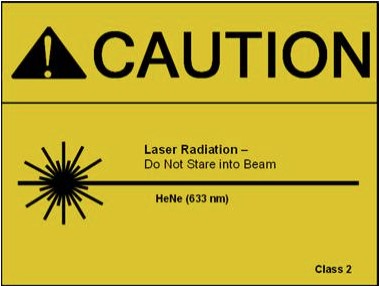
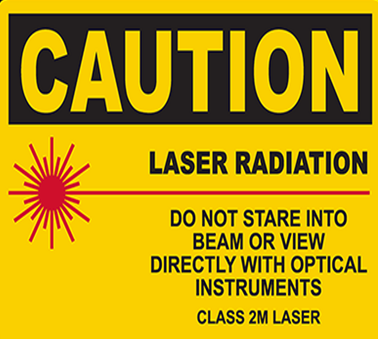
- Class 2 and Class 2M lasers both require two hazard notifications: a CAUTION label and an indicator light when the laser is in operation.
- CAUTION labels for Class 2M laser should include the words “Do Not View Directly with Optical Instruments”. See Figures 1 and 2 for examples of the required signage for Class 2 and 2M laser areas.
- Never overcome the natural aversion response and forcefully stare into the laser beam.
- Never point or aim the laser at the eye of a person or animal.
- Never use an optical instrument such as a telescope or magnifying optic to view the beam directly.
2. Class 3 Lasers
- General
These medium-powered lasers usually present a serious potential for eye injury resulting from intrabeam viewing, (especially Class 3B laser beams). Class 3 lasers generally do not present diffuse reflection hazard, skin hazard, or fire hazard. Therefore, control measures for Class 3R and 3B lasers focus on eliminating the possibility of viewing any intrabeams.- Never point or aim the laser at the eye of a person or animal.
- Use appropriate laser safety eyewear to prevent eye exposure to the beam or a hazardous specular reflection.
- Never place the unprotected eye along or near the beam axis. Some alignment procedures requiring close proximity to the beam present increased risk of exposure to hazardous specular reflections.
- Always keep laser beam paths above or below eye level for either sitting or standing positions.
- Never look directly into a laser beam with optical instruments unless an adequate protective filter is present within the optical train.
- Eliminate unnecessary specular (mirror-like) surfaces from the vicinity of the laser beam path or avoid aiming at such surfaces.
- Never aim at doorways or windows.
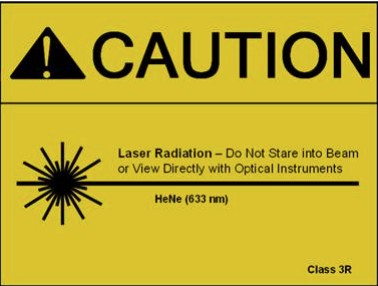
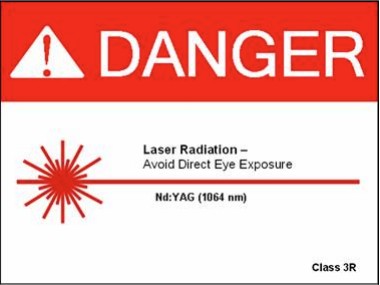
- Label lasers with appropriate Class 3 hazard notifications. See Figures 3 and 4 for examples of required signage for general Class 3 lasers based in MPE values that are not 3B level.
- Additional control measures for Class 3B Lasers
- All operators of Class 3B lasers must receive proper and appropriate training for authorization to use a laser.
- Never leave an operable laser unattended, especially around unauthorized individuals. Use a key switch if untrained individuals may gain access to the laser space or area.
- Use a warning light or buzzer to signal when the laser is in operation.
- Enclose as much of the beam path as is practical.
- Terminate the primary and secondary beams, if possible, at the end of the useful paths.
- Use low power settings, beam shutters and laser output filters to reduce the beam power to less hazardous levels when the full output power is not required.
- Ensure that spectators are not subjected to possible exposure of hazardous laser conditions.
- Operate the laser only in a well-controlled area such as within a closed room with covered or filtered windows and controlled access.
- Never permit tracking of non-target vehicles or aircraft during outdoor use of the laser.
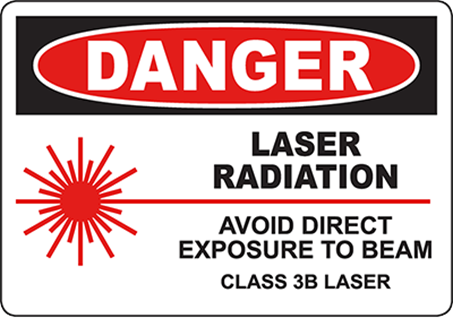
- Label lasers with appropriate Class 3B danger statements, and placard hazardous areas with danger signs if personnel can be exposed. See Figure 5 for an example of the required signage for Class 3B laser areas.
- Mount the laser on a firm support to ensure that the beam travels along the intended path.
3. Class 4 Lasers
- Enclose the entire laser beam path if possible. Enclosures may facilitate the laser status being reverted to a lower hazard classification.
- Confine operations of open beam lasers to light-tight rooms indoors.
- Interlock entrances to ensure that the laser beam will not emit upon opening of door when the NHZ extends to the entrances.
- Ensure that all personnel wear adequate eye protection or that a suitable shield is present between the laser beam(s) and personnel. Refer to ANSI 136.1 for information on suitable shields for lasers.
- Use remote firing and video monitoring when possible and ensure remote viewing is conducted through a laser safety shield when feasible.
- When the laser is employed outdoors, ensure that the beam will not intercept occupied areas or aircraft. Note: Special permissions are required to use a laser outside on UA grounds.
- Use lower power settings when possible. Employ beam shutters or laser output filters for reducing the laser beam irradiance to less hazardous levels when full beam power is not required.
- Ensure that the laser device has a key-switch master control to permit only authorized personnel to operate the laser.
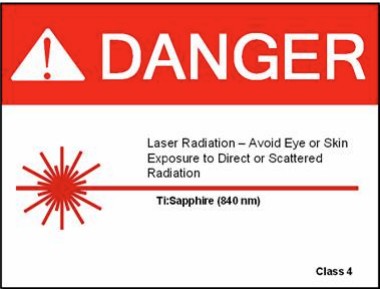
- Install appropriate signs (and labels if needed). See Figure 6 for an example of the required signage for Class 4 lasers.
- Optical pump systems may be hazardous to view since, when charged for pulsed lasers, a spontaneous discharge may result causing the laser to fire unexpectedly.
- Use dark, absorbing, diffuse, fire resistant target and backstops when feasible.
- Incorporate safety measures and procedures into laser welding, cutting equipment, and laser devices used in all types of material processing.
- Securely fasten all mirrors, prisms, beam stops, etc. in the beam path.
- Ensure that work is conducted in a light-tight or baffled interlocked enclosure for Class 4 laser systems with integrated microscopes or other focusing optics. This may permit the use of less restrictive laser safety eyewear that does not reduce vision. The need for laser safety eyewear for Class 4 lasers is never completely eliminated regardless of the control measure.
B. Specific Guidelines for Electrical Hazard
- Precautions for all lasers
- Employ the buddy system, especially after normal working hours or in isolated areas.
- When fatigued or using medication that could impair judgment, avoid all hazardous activities. Avoid hazardous activity when mental attitude, whether through emotional or chemical stimuli, would incline a person toward risk taking. Learn CPR rescue procedures for helping victims of apparent high voltage shock: Kill the circuit, remove the victim with a non-conductor if still in contact with an energized circuit, initiate CPR respiration immediately, call for emergency aid, and continue respiration until relieved by emergency medical staff.
- Avoid wearing rings, metallic watchbands, and other metallic objects when working with energized and plugged lasers.
- When possible, use only one hand in working on a circuit or control device.
- Never handle electrical equipment when hands, feet or body are wet, perspiring, or when standing on a wet floor.
- When working with high voltages, regard all floors as conductive and grounded unless covered with a well maintained, dry rubber matting of a type suitable for electrical work.
- Clearly identify the circuit breakers for each laser.
- Precautions for high-powered lasers
- Employ fault-current-limiting devices such as fuses or resistors, capable of clearing or dissipating total energy. In some cases, these are incorporated in the laboratory bench wiring.
- Use suitable enclosures and barriers to protect against projectiles that may occur during faults.
- Use enclosures designed to prevent accidental contact with terminals, cables or exposed electrical contacts.
- Use a grounded metal enclosure that is locked and/or interlocked.
- Keep combustible materials away from capacitors to prevent or contain fires.
- Automatically dump or crowbar capacitors before opening any access doors to high voltage areas in laser systems.
- Ensure a sufficiently short discharge time constant for the capacitor in the grounding system.
- Ensure that each capacitor is discharged, shorted and grounded prior to accessing capacitor area.
- Ensure reliable grounding, shorting and interlocking.
- Install crowbars, grounding switches, cables, and other safety devices to withstand the mechanical forces that could result from faults or crowbar currents flow.
- Ensure that suitable warning devices such as signs and lights are available.
- Place shorting straps at each capacitor during maintenance while capacitors are in storage.
- Ensure that manual grounding equipment has the connecting cable visible for the entire length.
- Ensure the availability of safety devices such as safety glasses, rubber gloves and insulating mats.
- Ensure metering, control and auxiliary circuits are protected from possible high potentials even during fault conditions.
- Ensure capacitors containers are routinely inspected for deformities or leaks.
- Ensure the availability of a grounding stick with a discharge resistor at its contact point, an insulated ground cable (transparent insulation preferred), and a grounding cable permanently attached to the ground. Do not use a grounding stick to ground a large bank of capacitors. Large capacity shorting bars, with resistors, should be part of stationary equipment. Use a solid-conducting grounding rod to ensure complete discharge.
C. Engineering Controls
1. Interlocks and Controls
- The preferred method of engineering control is enclosure of the laser equipment or beam path.
- Class 3B and 4 lasers must be interlocked so that hazard warning signage is energized before or at the same time as the laser or laser system.
- Protective enclosures of Class 3B or 4 lasers should be interlocked to activate when opened and only reset manually.
- Service access panels that permit direct access to laser radiation associated with Class 4 lasers must have an appropriate warning sign, be interlocked, and require a tool for removal.
- Override or bypass of the door interlocks by a laser owner or manager in a laser area with a warning light can only occur if:
- Individuals accessing during the override are authorized personnel.
- No laser radiation hazard is present at the point of entry.
- Appropriate PPE is worn by the personnel accessing the area.
- An interlock bypass circuit is designed into the interlock control system.
- If interlocks are not feasible, the laser owner or manager may consider the use of alarms, voice warnings, danger lights, door locks, key cards, or extensive security. The LSO must be consulted and provide approval for alternatives to interlocks.
- Laser work areas must be designed for easy navigation during normal operations and emergency conditions.
- All Class 4 lasers must have a master switch operated with a key or coded access (i.e., computer authorization password) that prevents use upon removal of the key or incorrect entry of the passcode. Never leave the key in the control panel when the laser is not in use.
- Ensure the presence of an alarm, warning light, or verbal countdown command to signal activation with a Class 4 laser. Include an emission delay for Class 4 lasers to allow action to prevent exposure.
2. Beam Enclosure
- Surround the entire beam path of Class 4 lasers, including the target area, by an enclosure equipped with interlocks to prevent operation of the laser system until the enclosure is properly secured. When total enclosure of the laser beam path is not possible, both the non-enclosed laser beam and any strong reflections must be terminated at the end of the useful path using devices such as backstops, shields or beam traps.
- Maintain laser radiation below the MPE for lasers with viewing portals by installing features such as interlock, filter, and or attenuators. Class 4 lasers must have permanently attached beam stop attenuators.
- Always set up the laser to ensure that the beam path is never at normal eye level (i.e., below 4.5 feet and above 6.5 feet).
- When the beam path cannot be fully enclosed, orient the laser system to ensure that the beam is directed outside the normal eye-level range, which is between 4.5 to 6.5 feet, from the floor. A beam path that exits from a controlled area must be enclosed when the beam irradiance exceeds the ocular MPE.
- All collecting optics intended for viewing use should incorporate means to maintain laser radiation transmitted through the collecting options to levels below the MPE.
3. Reflective Surface
- Controlled laser areas must be surveyed with appropriate measuring devices to locate and identify direct and reflected beams that exceed the MPE. Shielding may be necessary to limit unwanted radiation.
- Materials that diffusely reflect laser radiation must be used in place of specularly reflective surfaces whenever possible.
- Enclose or shield specularly reflective surfaces needed for beam-path control to minimize personnel exposure. Wearing jewelry such as watches, rings, or bracelets are often an overlooked source of exposure to a beam reflected by a mirror-like surface. Wearing jewelry is discouraged.
4. Invisible Beam Ultraviolet (UV) and Infrared (IR) Laser Requirements
- UV and IR lasers that emit invisible beams require shielding that must be installed to lower UV radiation to levels below the MPE for the wavelength being used.
- UV and IR lasers that emit invisible beams require the control of hazardous concentrations of by-products formed by the reaction of intense UV radiation with materials in the area.
- IR beam enclosures and backstops must be made from IR-absorbent material and must be fire-resistant.
- Terminations for IR laser beams with a wavelength greater than or equal to 710 nm must be made of fire-resistant material.
D. Laser Control Area
As previously mentioned, laser hazard analysis will be conducted by the LSO. If the analysis determines that the classification associated with the maximum level of accessible radiation is Class 3B or 4, a laser control area shall be established. The Owner of Manager of a Class 3B or 4 laser control area must:
- Ensure only diffusely reflecting materials are used in or near the beam path whenever feasible.
- Limit access to authorized personnel and employ sufficient security measures to prevent the entry of unauthorized personnel.
- Enforce use of appropriate PPE for all personnel within the laser area.
- Ensure that the exposed beam path is above or below eye level for a person in any sitting or standing position (exception may be provided for medical use).
- Cover all windows, doorways, portals, or openings to provide barriers that will reduce transmitted laser radiation to levels below the applicable ocular MPE.
- Store or disable the laser or any source of activation to the laser when not in use.
- Clearly identify a conspicuous marked emergency shut off to deactivate the laser.
E. Laser Alignment
- The majority of laser accidents occur while aligning the laser or during similar beam manipulation activities. All possible precautions should be taken to minimize the occurrence of such accidents. These activities require carefully developed site-specific hands-on training including hazard identification and mitigation techniques. Only laser users who have received training and are authorized by the laser owner or manager can perform laser alignment/beam manipulation activities unsupervised.
- The following laser alignment techniques should be included in every laser alignment procedure.
- Never view the laser beam directly. Viewing should be indirectly (via Web cam, CCD, IR/UV Viewer, electronic sensor, video camera, etc.)
- Reflective jewelry, ID badges, etc. that may intercept the laser beam must not be worn by those handling the laser.
- Minimize specular reflections. The individual manipulating or moving the optics is responsible for verifying that there are no stray reflections. Any stray reflections must be contained on the optical table even if observed below an eye hazard level. Alignment should be conducted in an optic-to-optic manner while constantly checking for stray reflections.
- Alignment procedures must be performed at the minimum required laser output.
- Remote viewing should always be considered and encouraged.
- When feasible, consider the use of low-power, co-axial visible alignment beams.
- Only use alignment eyewear for visible beams with the approval of the LSO.
- Terminate the beam path at the end of its useful path.
- Locate the beam path at a point other than eye level when standing or when sitting at a desk.
- Orient the laser so that the beam is never directed towards entry doors or aisles.
- Securely mount the laser system on a stable platform to maintain the beam path in a fixed position during operation and limit beam traverse during adjustments.
- Clearly identify beam paths and ensure that they do not cross populated areas or traffic paths.
- Use beam blocks, perimeter guards, complete table enclosures, etc. to confine primary beams and dangerous reflections to the optical table. Any exceptions to this (beam crossing walkways, beams from one room to another, vertical beams), must be discussed with the LSO and carefully planned. Use labeled beam blocks, enclosed tubes, etc. to mitigate any associated hazards.
F. Chemical Agents
- Control measures for halogens include gas cabinets with flow indicators and halogen sensors along with stainless steel or non-corrosive supply tubing.
- Control measures for hazardous dyes and solvents include the use of exhaust ventilation, emergency eyewashes and safety showers, and containment of pumps and reservoirs.
- Personal protective equipment, such as safety glasses and gloves, are also necessary for handling hazardous materials. Refer to the Chemical Hygiene Policy and the Chemical Hygiene Plan for additional information on hazard controls when handling hazardous materials.
VI. Personal Protective Equipment (PPE)
PPE serves as the last line of defense for protection against hazards. The following guidance on PPE use is provided predominantly for working with Class 3B and 4 Lasers. Protective eyewear in the form of safety glasses or goggles with appropriately filtering optics can protect the eyes from the reflected or scattered laser light with a hazardous beam power, as well as from direct exposure to a laser beam. Eyewear is rated for optical density (OD), which is the base-10 logarithm of the attenuation factor or coefficient by which the optical filter reduces beam power. (See Table 1 in Appendix). For example, eyewear with OD 3 will reduce the beam power in the specified wavelength range by a factor of 1,000. Please note that laser protective equipment is not a substitute for safe work practices. Also, additional PPE may be necessary when working with hazardous materials commonly used with lasers, such as cryogens, halogens, dyes, or organic solvents. Required personal protective equipment (PPE) should be included in the SOP for the use of lasers.
A. Eye
- Laser protective eyewear must be approved by the ANSI Standard ANSI Z136.1 and clearly labeled with OD’s and wavelengths for which protection is afforded.
- The LSO will review and approve appropriate protective eyewear in accordance with ANSI Z136.1 that reduces the potential ocular exposure to below applicable ocular MPE levels. Eyewear must be selected for the specific type of laser to block or attenuate at the appropriate wavelength range. For example, eyewear absorbing at 532 nm would be useless as protection against a laser emitting at 800 nm. Safety glasses may shatter, and plastic lenses may melt when maximum irradiance or radiant exposure for the particular lens is exceeded.
- Eye protection must be worn by all persons in areas where Class 3B or 4 lasers are operated unless approval has been provided by the LSO for an SOP with engineering or administrative controls sufficient to eliminate potential exposure in excess of the applicable ocular MPE. Laser owners or managers must ensure that at least one extra set of laser safety eyewear is available for access in emergency situations.
- Laser protective eyewear must be specifically selected to withstand both direct and diffusely scattered beams. The protective filter must exhibit a damage threshold for a specified exposure time (typically reported for 10 seconds). Studies have indicated that existing laser eye protective filters (plastic, glass, interference, or hybrid filters) often exhibit non-linear effects such as saturable absorption when exposed to ultra-short (femtosecond) pulse durations. In addition to a sufficient OD, laser eyewear used where direct beam exposure is possible should be able to withstand a direct strike from the laser beam without breaking.
- When purchasing laser safety eyewear, request the following information with every new pair of eyewear from the manufacturer:
- Corresponding OD and wavelength for protective eyewear.
- Any pertinent test data pertaining to protective eyewear and laser safety such as the factor of flammability (Refer to ANSI Z87).
- Recommendations on storage.
- Instructions for proper cleaning methods.
- Laser protective eyewear should be reviewed before each use to protect the user. Laser protective eyewear shall be periodically cleaned and inspected for:
- Pitting, glazing, cracking, and discoloration of lens.
- Mechanical integrity.
- Leakage of light and coating damage.
- Eye protection such as safety glasses must be worn when working with hazardous materials and to protect against other types of physical hazards. Safety glasses are not a substitute for laser eyewear and must only be worn when laser is not in use. For additional information on eye protections when working with hazardous materials or other types of hazards, refer to the Personal Protective Equipment Policy, the Chemical Hygiene Policy, and the Chemical Hygiene Plan.
B. Skin
- Long pants, closed toed shoes, long sleeves and lab coats should be worn when working with hazardous materials commonly associated with laser systems.
- Additionally, barrier creams, should be applied to any potentially exposed skin when working with sources of UV radiation like lasers. Laser owners, managers, and research advisors must review process to provide guidance on adequacy or appropriateness of barrier cream.
- Users need to stay out of the beam path of a Class 4 laser. In some cases, tightly-woven, flame-retardant fabrics provide the best protection for some Class 4 lasers. No adequate PPE for skin is available for high-powered Class 4 lasers.
C. Other
In some instances, PPE for other types of hazards, such as respiratory and hearing protection, may be needed during laser use. Refer to the Personal Protective Equipment Policy for additional information on selection and use of PPE for hazards.
VII. Medical Surveillance and Incident Reporting
A. Medical Surveillance
Users of Class 3B or Class 4 lasers or laser systems may receive pre-and post-assignment eye examinations performed by a consulting ophthalmologist. While eye examinations are no longer mandated by the ANSI Standard for Lasers, the eye tests may be required under certain conditions such as when laser owners or managers mandate them or when an eye accident or injury occurs involving a laser. Contact the LSO for additional information if eye examinations are required for laser use.
When medical surveillance is required, baseline medical eye exams should include ocular history, visual acuity for far and near vision, macular function, and color vision discrimination. Additional eye exams should be performed as deemed necessary or during an exposure incident.
B. Laser Injury
- Users with a suspected injury due to occupational exposure to lasers must be treated according to the University On-the-Job Injury and Illness Policy.
- Employees must complete an Injury or Illness Report form following the required course of treatment outlined in the policy. A visit to an ophthalmologist for treatment may be required.
- Contact the LSO immediately after any potential accident or incident involving laser use.
- Records related to medical surveillance or treatment may be maintained indefinitely by the attending physician. The LSO and laser owners or managers should be provided with copies of all physician reports for baseline examinations and subsequent exams.
C. Accidents and Incidents
The most catastrophic effects from direct laser radiation include retinal injuries with loss of sight from visible and near-IR laser systems. Retinal injuries are essentially permanent with little chance of repair. Accidents and incidents can occur under the following conditions:
- Unanticipated eye exposure during alignment
- Misaligned optics and upwardly directed beams
- Improper use of available eye protection not used
- Lack of or insufficient enforcement of PPE use
- Equipment malfunction
- Improper methods of handling high voltage
- Intentional exposure of unprotected personnel
- Operators unfamiliar with laser equipment
- Lack of protection for non-beam hazards
- Improper restoration of equipment following service
- Failure to follow SOPs
- Bypass of interlocks
- Accidental switch on of power supply
- Accidental laser firing by unintentional capacitor discharge
- Alteration of beam path by moving laser or optical components
- Addition of optical components without regard for the effect on beam path or the reflected beam
- Damage to laser enclosure
- Removal of safety devices for beam adjustment or alignment
- Insertion of reflective materials into beam path
VIII. Noncompliance
- Immediately hazardous violations are infractions that are deemed, by the LSO, to present an immediate danger to persons who may be present in the laser area or facility.
- Initial and repeat violations to outlined Laser Safety Policies and guidance documents including SOPs will be documented by the LSO or other EHS personnel. The responsible laser owner or manager will be informed in writing of the nature of the noncompliance, corrective measures requested, and the consequences for failure to comply.
- In the event of an immediately hazardous situation, the LSO may immediately cease operation of the laser, secure the area, suspend the privileges of the responsible Laser Owner or Manager, and take other action as deemed necessary to protect the health of individuals or the safety of University facilities. The responsible Laser Owner or Manager shall be informed in writing of the nature of the violation, ways to implement corrective action, and steps to prevent future incidents.
- The Laser Safety Program is managed by Environmental Health and Safety (EHS), and as such is subject to any EHS outlined escalation procedures.
IX. Laser Pointers
Pen-sized laser pointers have become widely available and are now common presentation aids. Individuals operating a laser pointer must be aware of the hazards related to the direct beam and ocular effects attributed to the laser pointer, such as afterimage, flash blindness, vision dysfunction, or glare. Dangers can be compounded if exposure occurs while operating a moving vehicle or machinery.
Laser pointers are subject to limited restrictions as outlined in ANSI Z136.1- (most recent edition). According to the ANSI standard, laser pointers should not exceed the AEL for Class 3R and are exempt from area posting requirements. ANSI Z136.1 (2022) encourages education and training as the best approach for a safety program regarding laser pointers.
The FDA has addressed laser pointers under the definition of a surveying, leveling, and alignment laser product, which is included in 21 CFR Part 1040.11 of the U.S. Federal Laser Product Performance Standard. This standard indicates that the laser product must comply with all of the requirements for a Class 1, 2, or 3a laser product and not permit access to laser radiation. On December 11, 2023, the FDA reiterated warnings and provided guidelines to parents and school officials regarding the possible hazards associated with laser pointers.
Some states and localities create regulations in an effort to mitigate unrestricted use of laser pointers such as limitations on sales, possession, and usage.
Below are general guidelines outlining safe use of laser pointers.
- Never view laser pointers directly due to the possibility of potential eye injury, i.e., never stare into a pointer.
- At present, the potential for eye injury directly related to laser pointers has not been completely determined. Therefore, pointers will not be permitted at any time during athletic events on campus.
- Instructors or lecturers on campus may only use pointers as long as they meet the specifications outlined in ANSI Z136.1 (latest edition)
- Only lasers pointers of 5mW or less are permitted for unrestricted use at UA..
- Purchase laser pointers with a “CAUTION’ label as opposed to those with a “DANGER” label. Lasers with the “CAUTION” level are typically Class 2, while those with the “DANGER” label are Class 3 lasers. No laser pointer rated at a Class 3B should ever be used without special provisions and approval of the LSO. Please be aware that lasers with wavelengths of 400 to 500 nm (the blue light region) can cause biological effects of a photo- biological nature (such as sunburns).
- Laser pointers above 5mW may be registered at EHS by completing the Laser Registration Form on the EHS website.
- Never point a laser pointer (of any power) at any person, animal, or other object such as drones, aircrafts, etc.. Pointers should be used to point out or emphasize inanimate objects such as slide images, building components, or laboratory apparatuses, etc.
- Avoid “mirror-like” (specular) targets.
- Never view a laser beam using an optical instrument (such as binoculars, microscope, etc.) unless the LSO and appropriate safety personnel have approved the procedure.
- Always use lowest power rating possible and highest divergence when possible.
- At UA, laser pointers should not be treated as toys for children. Laser pointers cannot be used by children unless approved by the LSO for specific projects and under constant supervision. To prevent unsupervised use, removal of batteries when the laser is not in use is recommended.
- All laser pointers must be correctly and conspicuously labeled with the correct warning labels.
X. Appendix
A. Definitions and Terms
- Accessible Emission Limit (AEL) – the maximum accessible level of laser radiation permitted within a particular laser class.
- Attenuation Factor or Coefficient – the extent to which the intensity of the radiant flux of a laser beam is reduced as it travels through a medium.
- Inspection personnel – any individual who has responsibility for performing an inspection of the facility or the laser system. The LSO, members of outside regulatory agencies, and representatives of EHS are included under this heading.
- Laser Owner or Manager – any approved faculty or staff member at UA who owns a laser or laser system of any classification.
- Maximum Permissible Exposure (MPE) – the level of laser radiation to which a person may be exposed without hazardous effect or adverse biological changes in the eye or skin. Please note that the MPE is not an exact limit between safe and dangerous exposures, but a guideline employed to control exposures.
Due to different tolerances and damage thresholds, the ANSI Z136.1 standard lists separate MPE values for eyes and skin. The MPE for the eye is generally much more restrictive. When a new laser is registered with the Laser Safety Program, the MPE for eyes and skin will be calculated. These values should be included in the Laser Safety SOP and posted in the lab.
MPE’s are primarily dependent upon laser wavelength and exposure duration. Other factors, such as temporal mode (i.e., whether the laser is continuous wave or pulsed), the pulse repetition frequency, and others should be known to calculate the MPE. MPE tables for both eye and skin can be found in the ANSI Z136.1 Standard. - Nominal Hazard Zone (NHZ) – the physical area in which the MPE can be exceeded by direct, scattered, or diffuse laser radiation. NHZ is calculated using various parameters of the laser and the described use, including wavelength, MPE, beam power, divergence, emergent beam diameter, lens focal length, scattering angle, and others. Entry into the NHZ requires certain controls be in place such as mandatory protective eyewear. Typically, the NHZ is not applicable when the laser beam is totally enclosed from beginning to end. The NHZ should be known for any beam that is not totally enclosed. When a new laser is registered with the Laser Safety Program, the NHZ should be calculated. The NHZ will be reviewed within the laser usage area and additional controls will be implemented in that zone.
- User – any employee or student at UA documented by the owner or manager as having operational access to a laser or laser system.
- Visitor – any corporate researcher or visiting scholar working with, operating, or planning to work with a laser or laser system at UA. Each visitor must meet or exceed all of the requirements for a registered operator as outlined in this document.
B. Signage
1. General Information on Laser Hazard and Warning Signs
Guidelines for warning signs and labels related to laser-controlled areas are outlined in ANSI Z136.1-2022. Below are a few highlighted guidelines for posting warning signs and labels for lasers and laser-controlled areas.
- Labels and warning signs must be conspicuously displayed to indicate the presence of laser hazards.
- Post signs at entrances to laser-controlled areas.
- Ensure that hazard labels are affixed to the laser in a conspicuous location.
- All Class 2, 3, and 4 laser equipment must be labeled indicating hazard classification, output power/energy, and lasing material or wavelength with words and symbols.
2. Specific Examples of Laser Hazard and Warning Signage
C. Tables Related to Laser Power and Control Measures for Four Laser Classes
Table 1: Optical Densities for Protective Eyewear for Various Laser Types
Table adopted from Laser Control Measures in ANSI Z136.1 (21014)
| LASER TYPE/POWER | WAVELENGTH (µm) | OD 0.25 seconds | OD 10 seconds | OD 600 seconds | OD 30,000 seconds |
|---|---|---|---|---|---|
| XeCl 50 watts | 0.308a | — | 6.2 | 8.0 | 9.7 |
| XeFL 50 watts | 0.351a | — | 4.8 | 6.6 | 8.3 |
| Argon 1.0 watt | 0.514 | 3.0 | 3.4 | 5.2 | 6.4 |
| Krypton 1.0 watt | 0.530 | 3.0 | 3.4 | 5.2 | 6.4 |
| Krypton 1.0 watt | 0.568 | 3.0 | 3.4 | 4.9 | 6.1 |
| HeNe 0.005 watt | 0.633 | 0.7 | 1.1 | 1.7 | 2.9 |
| Krypton 1.0 watt | 0.647 | 3.0 | 3.4 | 3.9 | 5.0 |
| GaAs 50 mW | 0.840c | — | 1.8 | 2.3 | 3.7 |
| Nd:YAG 100 watt | 1.064a | — | 4.7 | 5.2 | 5.2 |
| Nd:YAG (Q-switch)b | 1.064a | — | 4.5 | 5.0 | 5.4 |
| Nd:YAGc 50 watts | 1.33a | — | 4.4 | 4.9 | 4.9 |
| CO2 1,000 watts | 10.6a | — | 6.2 | 8.0 | 9.7 |
Table 2: Engineering Control Measures for the Four Laser Classes
Table adopted from Laser Control Measures in ANSI Z136.1 (21024)
| Control Measures | Classification | |||||||||||||||||||||
|---|---|---|---|---|---|---|---|---|---|---|---|---|---|---|---|---|---|---|---|---|---|---|
| Engineering Controls | 1 | 1M | 2 | 2M | 3R | 3B | 4 | |||||||||||||||
| Protective Housing | X | X | X | X | X | X | X | |||||||||||||||
| Without Protective Housing | Laser Safety Officer (LSO) establishes alternative controls | |||||||||||||||||||||
| Interlocks on Protective Housing | Δ | Δ | Δ | Δ | Δ | X | X | |||||||||||||||
| Service Access Panel | Δ | Δ | Δ | Δ | Δ | X | X | |||||||||||||||
| Key Control | — | — | — | — | — | * | X | |||||||||||||||
| Viewing Portals | Assure Viewing Limited < MPE | |||||||||||||||||||||
| Collecting Optics | ||||||||||||||||||||||
| Totally Open Beam Path | — | — | — | — | — | X NHZ | X NHZ | |||||||||||||||
| Limited Open Beam Path | — | — | — | — | — | X NHZ | X NHZ | |||||||||||||||
| Enclosed Beam Path | None required if protective housing and interlocks are in place | |||||||||||||||||||||
| Remote Interlock Sensor | — | — | — | — | — | * | X | |||||||||||||||
| Beam Stop or Attenuator | — | — | — | — | — | * | X | |||||||||||||||
| Activation Warning Systems | — | — | — | — | — | * | X | |||||||||||||||
| Indoor Laser Controlled Area | — | — | — | — | — | — | X | |||||||||||||||
| Class 3B Indoor Laser Controlled Area | — | — | — | — | — | X | — | |||||||||||||||
| Class 4 Laser Controlled Area | — | — | — | — | — | — | — | |||||||||||||||
| Outdoor Control Measures | — | — | — | — | — | — | — | |||||||||||||||
| Laser in Navigable Airspace | X | * NHZ | X NHZ | * NHZ | NHZ | MPE | MPE | |||||||||||||||
| Temporary Laser Controlled Area | Δ MPE | Δ MPE | Δ MPE | Δ MPE | Δ MPE | — | — | |||||||||||||||
| Controlled Operation | — | — | — | — | — | — | * | |||||||||||||||
| Equipment Labels | X | X | X | X | X | X | X | |||||||||||||||
| Laser Area Warning Signs | — | — | — | X | * | X | X | |||||||||||||||
Legend:
X = shall * = should – = no requirement NHZ = NHZ analysis required
Δ = shall if enclosed Class 3B or 4 MPE = shall if MPE is exceeded
Table 3: Administrative Control Measures for the Four Laser Classes
Table adopted from Laser Control Measures in ANSI Z136.1 (21014)
| Control Measures | Classification | |||||||||||||||
|---|---|---|---|---|---|---|---|---|---|---|---|---|---|---|---|---|
| Standard Operating Procedure | — | — | — | — | — | * | X | |||||||||
| Output Emissions Limitations | — | — | — | — | — | LSO Determines | ||||||||||
| Education and Training | — | * | * | * | * | X | X | |||||||||
| Authorized Personnel | — | * | — | * | — | X | X | |||||||||
| Alignment Procedures | Δ | Δ | Δ | Δ | Δ | X | X | |||||||||
| Protective Equipment | — | * | — | * | — | * | X | |||||||||
| Spectator | — | * | — | * | — | * | X | |||||||||
| Service Personnel | Δ | Δ | Δ | Δ | Δ | X | X | |||||||||
| Demonstration with Public | — | * | X | * | X | X | X | |||||||||
| Laser Fiber Optic Systems | MPE | MPE | MPE | MPE | MPE | X | X | |||||||||
| Laser Robotic Installation | — | — | — | — | — | X NHZ | X NHZ | |||||||||
| Protective Eyewear | — | — | — | — | — | * NHZ | X NHZ | |||||||||
| Window Protection | — | — | — | — | — | X | X NHZ | |||||||||
| Protective Barriers and Curtains | — | — | — | — | — | * | * | |||||||||
| Skin Protection | — | — | — | — | — | X | X MPE | |||||||||
| Warning Signs and Labels | — | — | * | * | * | X NHZ | X NHZ | |||||||||
Legend:
X = shall * = should – = no requirement NHZ = NHZ analysis required
Δ = shall if enclosed Class 3B or 4 MPE = shall if MPE is exceeded
Printable